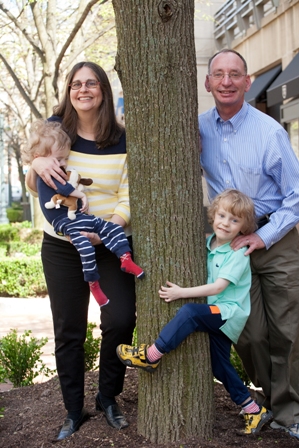
In April, our family (Edward,
Melanie and sons Brooks and Russell) attended
NTSAD's annual conference in Reston, Virginia.
Our 2 ½ year old son Russell is unique in that he has
two chromosome 15 defects: Prader-Willi Syndrome and Tay-Sachs Disease.
A useful conference session
featured Stephanie Bozarth talking about how she became
a rare disease research funding advocate following her
daughter's diagnosis with
Mucopolysaccharidoses (MPS). Stephanie
urged the families to meet with their members of
Congress either in Washington, or back home, to talk
about the compelling need for more medical research on
rare diseases.
Stephanie's talk inspired
me to reach out to the Congresswoman who represents my
home town of Denver,
Diana
DeGette, who was a classmate of mine at Colorado
College. Rep. DeGette is one of Congress's leading
advocates for health care research, and with Rep. Fred
Upton (R-MI), has launched a
21st Century Cures Initiative for
"government support to accelerate the pace of cures and
medical breakthroughs."
|
|
|
Rep. Diana DeGette, Ed and Melanie with their
sons Russell and Brooks (left to
right) |
Our entire family met with
Rep. DeGette on June 1st in her Capitol Hill office
overlooking
the Washington Monument.
During our visit, Melanie and I were able to tell the
story about the great care we are getting for Russell
from our physicians (Dr. Elizabeth Valois, Kaiser
Permanente and Drs. Cynthia Tifft and Deborah Reiger,
NIH) and also about the difficult process of getting
nursing and other assistance from the state of
Maryland.
Congresswoman DeGette
welcomed our narrative, saying it gave her context to
understand the problems families face when they have
children with rare diseases. She also encouraged us to
personally get involved in informing other members of
Congress about Tay Sachs, just as she had gotten
involved in the cause of Diabetes research from personal
family experience.
We also discussed the
challenge of getting congressional funding for rare
disease research. When I mentioned Stephanie Bozarth's
observation that NIH funding for research into the
disease affecting her daughter went up from $5 million
on an annual basis to $11 million, but then was cut to
$8 million when the Congress enacted a ten year
indiscriminant budget cutting measure in 2011 called
"sequestration," DeGette said that families need to tell
their members of Congress that health care funding is a
non-partisan and pressing issue, and that they need to
pay attention to areas such as rare disease research
where additional federal funding makes sense, and
wouldn't necessarily be addressed in the private market.
We left our meeting invigorated
to try to make a difference in our advocacy and to
encourage other Tay Sachs families to do the same. We've
learned from personal experience with other friends
who've become health care funding advocates that through
organized advocacy parents with children afflicted with
rare diseases can make a difference.
To learn more about how you
can advocate, contact Sue Kahn, Executive Director of
NTSAD, or Diana Pangonis, Family Services Director at
(617) 277-4463.